AI-Driven Radio Resource Management (RRM)
AI-Driven Radio Resource Management (RRM) is a cloud-based service in the RUCKUS AI platform that continuously optimizes RF settings across managed access points (APs) to reduce interference and improve Wi-Fi performance.
- Wi-Fi channel selection
- Channel width
- AP transmit power
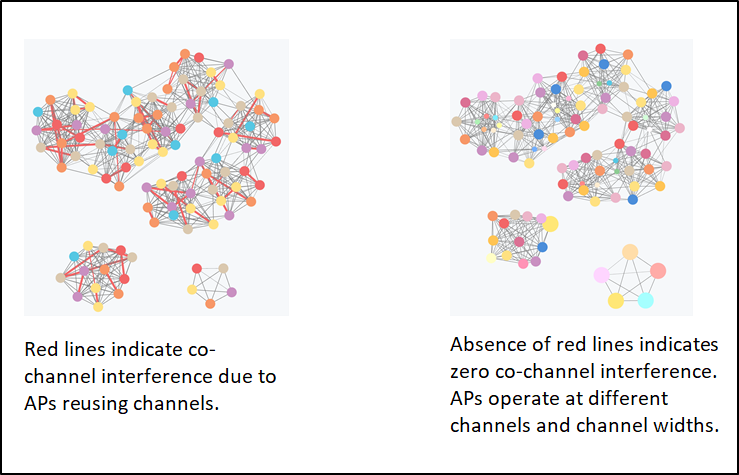
Using machine learning, artificial intelligence, graph-based optimization, and cloud-scale computation, AI-Driven RRM evaluates the RF environment across the entire network. This enables intelligent channel reuse, reduced co-channel interference, and improved wireless capacity and throughput.
Unlike traditional RRM approaches that rely on predefined policies or static configuration rules, AI-Driven RRM builds an RF plan for each AP, similar to the way an experienced RF engineer designs and tunes a wireless network. The algorithm evaluates each AP in the context of the entire deployment, considering neighboring APs, interference sources, DFS history, historical RF patterns, and channel reuse opportunities to determine the optimal channel, channel width, and transmit power for every AP.
Because AI-Driven RRM performs AP-specific RF optimization, the resulting settings are reflected as AP Overrides when the feature is enabled. These overrides represent the RF plan generated and continuously maintained by AI-Driven RRM.
- Historical RF Learning: Learns daily and weekly RF patterns to make more stable and informed RF optimization decisions.
- DFS Awareness: Tracks DFS radar events and evaluates the long-term stability of DFS channels. Channels that experience frequent radar events may be deprioritized, while stable DFS channels remain candidates when they provide a network-wide performance advantage.
- Rogue Network Assessment: Analyzes neighboring and rogue Wi-Fi networks and evaluates their impact on the RF environment. Rather than automatically avoiding occupied channels, the algorithm makes a balanced assessment of interference levels, AP density, channel availability, and channel reuse opportunities to determine whether channel reuse or channel avoidance will deliver the best overall network performance.
- Intent-Based Guardrails: Through IntentAI, administrators can optionally define guardrails for channel width and transmit power adjustments. AI-Driven RRM honors these administrator-defined boundaries while performing RF optimization, ensuring that optimization decisions align with site-specific operational and design requirements.
By jointly optimizing channel selection, channel width, transmit power, DFS channel usage, and channel reuse strategies, AI-Driven RRM makes balanced, network-wide RF decisions that improve network efficiency and user experience.
Like other AI features, AI-Driven RRM recommendations are available as an intent in the IntentAI page. When a new AI-Driven RRM recommendation is available, IntentAI allows you to choose your intent by specifying the network priority while applying the recommendation. For more information about the AI-Driven RRM intent, network priority and scope, refer to AI Feature-specific Intents, Network Priorities, and Scope.
Benefits of AI-Driven RRM for an End User
End users benefit from improved connectivity as they move throughout the environment, more consistent performance during periods of high network utilization, and reliable access to business-critical applications such as voice, video conferencing, collaboration platforms, and cloud services. By continuously adapting to changing RF conditions, AI-Driven RRM helps deliver a high-quality Wi-Fi experience without requiring ongoing manual RF tuning by network administrators.
Advantages of AI-Driven RRM for a Network Administrator
While professional wireless engineers routinely optimize their network performance by selecting channel and power settings in addition to tuning other available configuration settings, this task is getting more difficult with the advent of the 6 GHz spectrum. A glance at the newly introduced spectrum and the available channel and channel width options make it tedious to manually optimize channel and channel width parameters required for a properly tuned Wi-Fi network. Not all enterprises have the wireless RF professionals available to tune these settings across the network. For a busy network administrator, sub-optimal conditions often go undiscovered until an end-user escalation.
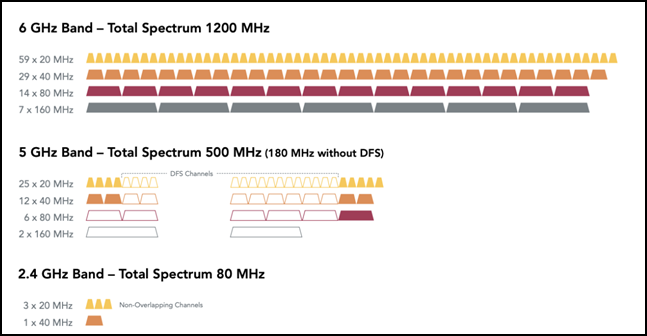
With AI-Driven RRM, network conditions are continuously monitored in real-time. When a sub-optimal configuration is detected, the network administrator is presented with an optimized choice of channel, channel width, and AP transmit power in the form of an intent. With a single click, the administrator can apply the most optimal parameters to all the APs in a venue.
Once the intent is applied, IntentAI continues to autonomously monitor the network and applies an updated, AI-modeled channel plan when necessary. The changes are applied at the user-specified time. It is recommended to pick off-peak hours when the network is less busy to make the change to ensure minimal disruption. This automatic process continues indefinitely until the user chooses to revert or pause the intent. If the user chooses to pause the intent, all automation workflows are halted, and the network remains in its current state without triggering any configuration changes. During this paused state, KPI monitoring, ML model generation, recommendation updates, and configuration changes are suspended, ensuring no further adjustments occur until the intent is resumed. If reverted, the original configuration is restored.
Prerequisites for AI-Driven RRM
- The venue must have at least two APs.
AI-Driven RRM Considerations
- Once AI-Driven RRM is applied on a Venue, the Venue-level Channel Selection Method remains visible for reference but is no longer honored. AI-Driven RRM creates a per-AP RF plan, determining the optimal channel, channel width, and transmit power for every AP based on its RF environment. These settings are then automatically applied using AP override capabilities at the user selected time of the day.
- The background scanning configuration and scanning interval is not changed but continues to operate collecting data to discover the RF neighborhood that is used for seamless roaming, rogue AP detection, and AI-Driven RRM algorithms.
- AI-Driven RRM enables rogue detection at the venue level. This is done to gather a complete RF picture of the environment before optimization decisions are made.
- AI-Driven RRM recommendations are triggered only for venues with 100 percent licensed APs. Any unlicensed APs added to the venue after AI-Driven RRM is applied are not considered, which may result in sub-optimal channel planning in the venue.
- AI-Driven RRM does not operate when venues have active mesh APs.
- Tenants with Professional and Essentials license can make use of AI-Driven RRM.
- AI-Driven RRM recommends channel, channel width, and AP transmit power configuration items at the venue level. The network administrator is required to pick a date and time to apply the configuration. This is the local time for the venue for which recommendation is made. It is a best practice to include access points in the same time zone in a venue because off-peak hours might differ across time zones.
AI-Driven RRM Behavior in 2.4 GHz
It is generally accepted and understood that 2.4 GHz is a crowded spectrum with only three non-overlapping channels. However, it is important because several clients still support only the 2.4 GHz band. RF propagation characteristics unique to 2.4 GHz make it a useful choice due to its increased range.
Since the 2.4 GHz band has only three non-overlapping channels (1, 6, and 11), it is likely that APs in this band will hear other APs, and a "zero interfering links" solution does not exist in dense AP deployments in 2.4 GHz. In this scenario, AI-Driven RRM will still aim for the lowest possible co-channel interference. It does not take action to turn off AP radios in the 2.4 GHz band.
AI-Driven RRM with Dynamic Frequency Selection Channels
AI-Driven RRM is aware of the constraints that Dynamic Frequency Selection (DFS) channels pose in 5 GHz spectrum usage. While the actual decision to operate in a DFS channel is still done at an AP radio level after radar detection measures have been applied, AI-Driven RRM keeps track of radar activity on different DFS channels and intelligently crowdsources this information across multiple APs within the same physical proximity. Based on this crowdsourced information, AI-Driven RRM may restrict the use of some of these DFS channels to avoid disruptions to end users. Of course, optimality in terms of zero interfering links and channel bandwidth selection will still be maintained.
AI-Driven RRM Operation at Venue and AP Levels
AI-Driven RRM Interoperability in a Mixed AP Deployment
The AI-Driven RRM algorithm works on the information it receives from RUCKUS access points. Any third-party access point is treated as a rogue AP. These data points are fed into the computation to search for the best option for channel, channel width, and AP transmit power. These changes are recommended to the network administrator using the AI recommendation mechanism. There is no deauthentication action taken against rogue APs because the algorithms have built-in rogue AP avoidance. Even in the presence of rogue access points or third-party access points, AI-Driven RRM delivers the most optimum solution for interfering AP links and co-channel interference possible.
AI-Driven RRM with Automated Frequency Coordination
AI-Driven RRM is enhanced with configuration from Automated Frequency Coordination (AFC) for 6 GHz channel allocation in the US region.
AFC is a system designed to manage spectrum use in the 6 GHz band, maximizing spectrum access and minimizing interference between unlicensed Wi-Fi 6E/7 devices and licensed devices. AFC involves a registered database that contains information about all licensed users currently operating in the 6 GHz band in a specific area. When a new Wi-Fi device, such as an AP, wants to operate in the 6 GHz band, it must register with the AFC system, and thereafter must check in with the system every 24 hours, to obtain a current list of available channels on which to operate. These periodic checks ensure its operation will not interfere with registered devices already using that band. Standard power APs, especially when used outdoors, have a higher potential to interfere with existing 6 GHz users. Therefore, these APs must use the AFC system to protect incumbent operations from RF interference. The AFC system is crucial for maintaining harmony in the spectrum usage, allowing new and existing technologies to coexist without disrupting each other’s services. Without AFC registration, indoor APs operate in low power mode and outdoor APs cannot operate in the 6 GHz spectrum at all.
AI-Driven RRM solves this by integrating AFC (based on AFC’s channel list) to provide better optimized network configurations. When the channel list is selected for RRM, instead of using only the channels defined in RUCKUS One, RRM will consider the AFC response data from the APs and compare the AFC channel list with the controller-configured channels. The overlapping or common channels identified through this comparison will be utilized to provide an optimized configuration recommendation.
Considerations for AI-Driven RRM with AFC
- AI-Driven RRM recommendation must be in the Applied state.
- AI-Driven RRM based on AFC is applicable only to the US region.
- AFC is required for indoor and outdoor 6-GHz APs running in Standard Power mode.