Viewing and Managing the Network List
You can view and manage Wi‑Fi networks and access detailed information for each network.
-
On the navigation bar, select
.
The Wi-Fi Networks page is displayed with the following information:
- Name: Displays the Wi‑Fi network (SSID) name. The name is a hyperlink; clicking it opens the details page for the selected Wi‑Fi network.
- Description: Displays the description for the Wi‑Fi network.
- Type: Displays the WLAN security or authentication type (for example, Dynamic Pre-Shared Key).
- Venues: Displays the number of venues where this Wi‑Fi network is available. The number is a hyperlink; clicking it opens the Venues tab for the selected Wi‑Fi network.
- APs: Displays the number of access points that advertise this Wi‑Fi network; a warning indicator may appear when attention is required. The number is a hyperlink; clicking it opens the APs tab for the selected Wi‑Fi network.
- Clients: Displays the number of clients currently connected to this Wi‑Fi network. The number is a hyperlink; clicking it opens the Clients tab for the selected Wi‑Fi network. The Clients list is automatically filtered based on the selected network.
- VLAN: Displays the VLAN name or ID associated with this Wi‑Fi network.
- Security
Protocol: Displays the configured security protocol (for
example, WPA2 Enterprise).
Wi-Fi Networks 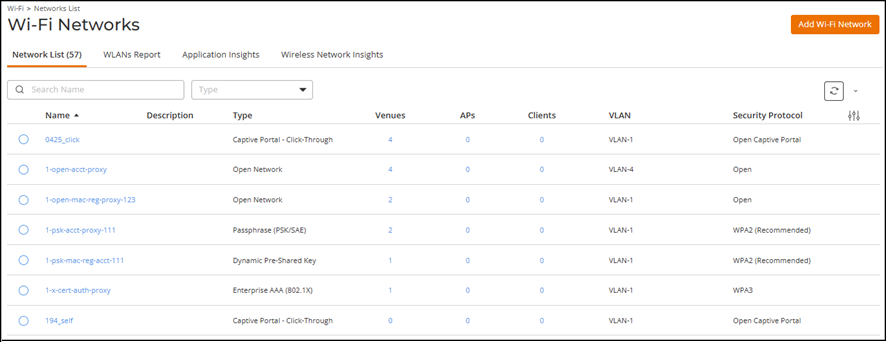
You can use the Search option to display only the Wi‑Fi networks matching the specified name; enter a minimum of two characters. Additionally, you can filter the list by selecting options from the drop‑down menu of the Type field. The type filter supports multiple selections, including the following options: Passphrase (PSK/SAE), Dynamic Pre‑Shared Key, Enterprise AAA (802.1X), Hotspot 2.0 Access, Captive Portal, and Open Network. The Captive Portal includes Click‑Through, Self Sign‑In, Cloudpath Captive Portal, Host Approval, Managed Guest Pass, 3rd Party Captive Portal (WISPr), Active Directory / LDAP Server, SAML Identity Provider (IdP), and Workflow.Note: After you apply a search or filter, the remaining filter options are updated based on the current results. Previously selected filter values remain applied even if they are not displayed in the updated filter list.You can customize which fields appear in the table by clicking the
 icon and selecting or deselecting the desired column names. Drag and drop
individual column names up or down the list to customize the left‑to‑right
column display in the table. Optionally, you can click Reset to
default to restore the default subset of columns.
icon and selecting or deselecting the desired column names. Drag and drop
individual column names up or down the list to customize the left‑to‑right
column display in the table. Optionally, you can click Reset to
default to restore the default subset of columns. Click Clear Filters to remove all applied filters and restore the complete list of Wi‑Fi networks. You can sort the list by name, description, type, or VLAN by the associated column header.
You can also use the
 icon to update the table with the most recent network data. The
Auto
Refresh toggle automatically refreshes the table at regular
intervals when enabled, ensuring that the displayed Wi‑Fi network
information remains current without a manual refresh.
icon to update the table with the most recent network data. The
Auto
Refresh toggle automatically refreshes the table at regular
intervals when enabled, ensuring that the displayed Wi‑Fi network
information remains current without a manual refresh. -
(Optional) Select the radio
button alongside the Name of the network to display the
following options:
- Edit: Modify the selected Wi‑Fi network. Refer to Editing a Network for more details.
- Clone: Create a copy of the selected Wi‑Fi network. Refer to Cloning a Network for more details.
- Delete:
Remove the selected Wi‑Fi network. Refer to Deleting a Network for more
details.
Wi-Fi Networks - Wi-Fi Network Management Options 