Importing DPSK Passphrases from a CSV File
Note:
- You must have permission to import passphrases for the selected DPSK service.
- Before importing DPSK
passphrases, ensure that the CSV file meets the following requirements:
- The file must be in CSV format, must not exceed 5 MB in size, and must contain no more than 10,000 entries.
- The file must include all required column headers from the downloaded template. Header names must match exactly.
- The file must contain at least one valid data row.
- Only one MAC address value is supported per row.
- When editing the file in Microsoft Excel, save it in CSV format and set all cells to Text to preserve UTF‑8 encoding.
-
From the navigation bar, select
Network
Control > My
Services.
The My Services page is displayed.
-
Select DPSK.
The DPSK page is displayed.
-
Click the specific DPSK service
name.
The DPSK service details page is displayed, defaulting to the Overview tab.
-
Click the
Passphrases tab.
Passphrases Tab
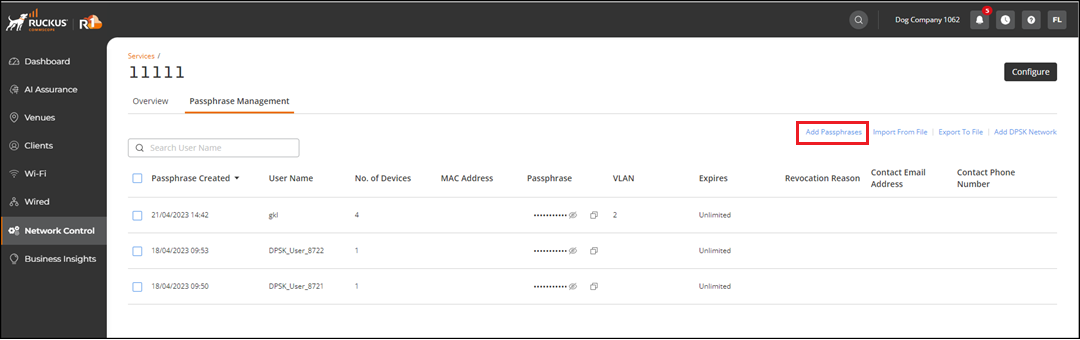
- Click Add....
-
Select Import From
File.
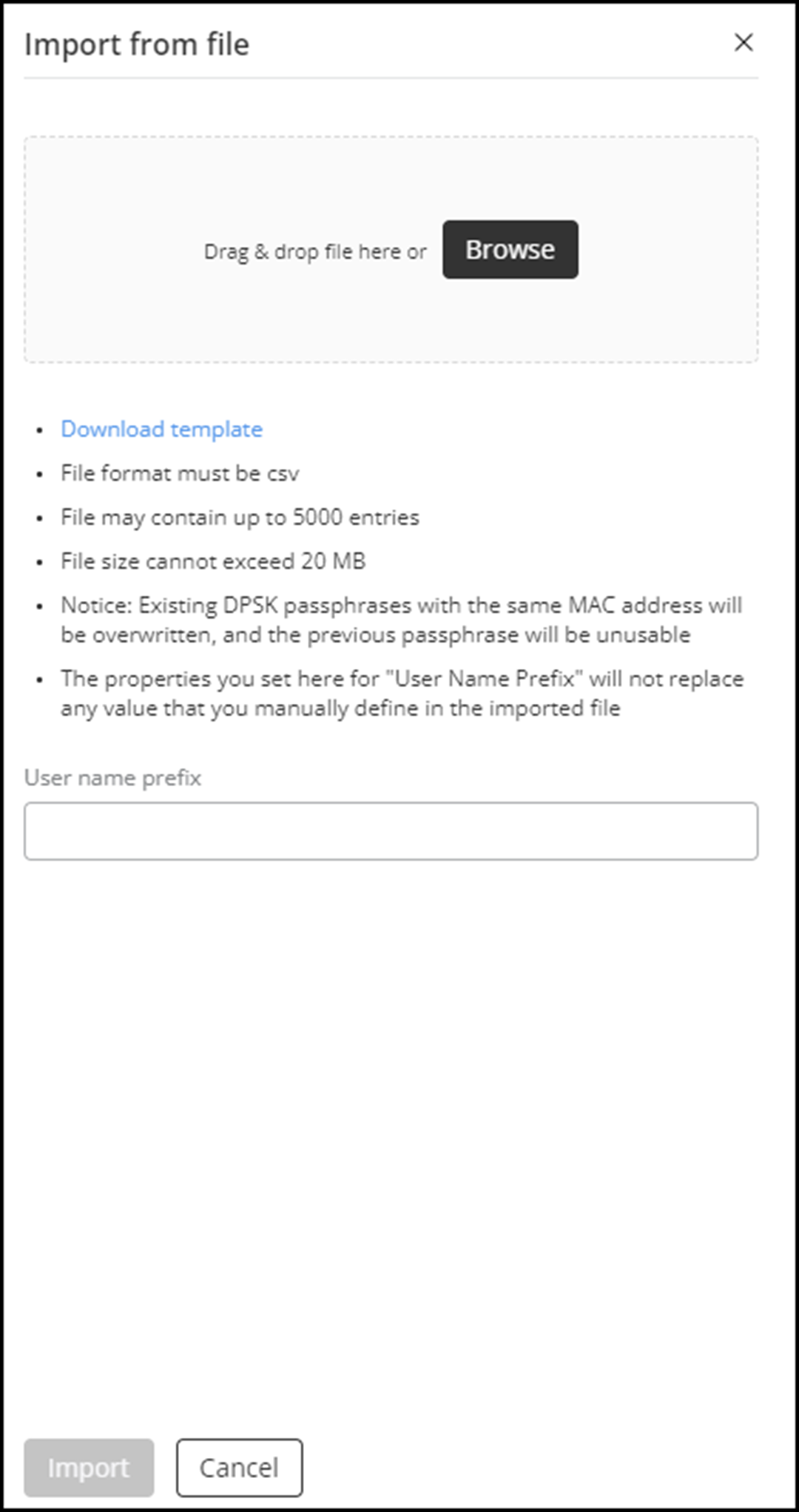
The Import from file sidebar is displayed.
Import from file
-
(Optional) Click Download template
to download the DPSK import template locally, then edit and save the file on
your local device.
Note: The following columns appear in the CSV file; apply the following guidelines when preparing the CSV file for importing DPSK passphrases:
- (Optional) Username: Enter a username for the passphrase. If you have not defined a User name prefix and leave this field empty, the system automatically generates a username. The username must be unique within the CSV file and must not already exist.
- (Optional) Number of devices: Enter the number of devices associated with the passphrase. The valid value range is 1–512. If you leave this field empty, the system sets the value to 1. If you specify a MAC address, set this value to 1.
- (Optional) MAC Address: Enter the MAC address of the device. Only one MAC address is allowed per row. Supported formats include 12:34:56:78:90:ab, 12‑34‑56‑78‑90‑ab, 123.456.789.0ab, and 1234567890ab. When you specify a MAC address, the Number of devices value must be 1.
- (Optional) Passphrase: Enter the passphrase. If you leave this field empty, the system generates a passphrase automatically. Each passphrase must not include unsupported special characters and the length of each passphrase must meet the Passphrase Length criteria configured for the DPSK service, otherwise the import will fail. Each passphrase entry is processed independently and may succeed or fail without affecting other entries.
- (Optional) VLAN ID: Enter the VLAN ID for the passphrase. If you leave this field empty, the default VLAN configured for the network is used. The valid value range is 1–4094.
- (Optional) Passphrase Expiration: Specify when the passphrase expires. If you leave this field empty, the expiration value configured in the linked DPSK network is used. Supported values are UNLIMITED, ONE_DAY, TWO_DAYS, ONE_WEEK, TWO_WEEKS, ONE_MONTH, SIX_MONTHS, ONE_YEAR, and TWO_YEARS.
- (Optional) Email: Enter the email address of the passphrase owner in a valid format (username@domain containing no spaces and no more than 320 characters).
- (Optional) Phone Number: Enter the phone number of the passphrase owner. The value must start with +, followed by the country code and phone number. The column header must be PhoneNumber with no space.
-
Drag and drop your local CSV
file into the upload area or click Browse to select
the CSV file and upload it.
Note: The system validates the CSV file when you upload it. Files that fail validation are rejected before the import starts.After the file is uploaded, the file name is displayed along with a Change File button.
- (Optional) Click Change File if you want to remove the uploaded file and select a different CSV file.
- (Optional) Enter a value in the User name prefix field to generate usernames only if they are missing from the CSV file. Manually defined usernames are not replaced.
- Select an Identity Group from the drop‑down list. If multiple identity groups are associated with the DPSK service, select the Identity Group to which the imported passphrases will be assigned.
-
Click Start
Import.
The Import from file sidebar closes automatically and an in-progress toast notification appears at the bottom-right corner of the GUI, displaying the total number of identities and passphrases being processed, the completion percentage, and a Details link that launches the Activity Details sidebar.Note:
- Invalid rows are skipped and valid rows continue importing.
- Each passphrase entry is processed independently and may succeed or fail without affecting other entries.
-
Click the Details link to
view the Activity Details sidebar.
Note: The toast notification remains on the screen until all import activities are complete.
Activity Details Sidebar
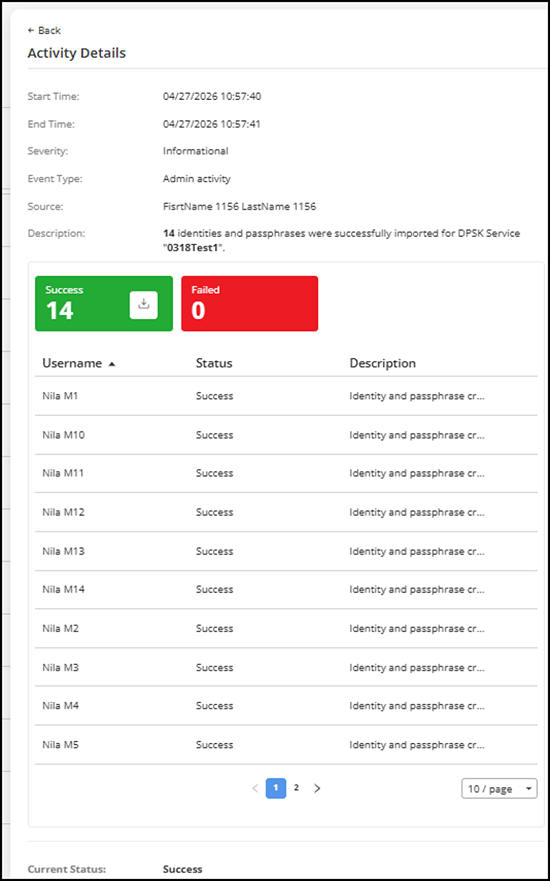
The Activity Details view refreshes automatically and displays information about the DPSK passphrase import.
The view displays the Start Time, End Time, Severity, Event Type, Source (the user who initiated the import), and a Description. While the import is in progress, the description shows the number of identities and passphrases being created and the overall completion percentage. After the import completes, the description displays the final number of successful and failed entries and includes the Download the error report link if failures occurred.
The Activity Details view includes the following status panels:- Success: Displays a green panel showing the number of identities and passphrases imported successfully.
- Failed: Displays a red panel showing the number of identities and passphrases that failed to import.
- In Progress: Displays a gray panel showing the number of identities and passphrases still being processed.
The table in the Activity Details view displays the import results for each entry:
- Username: Displays the username associated with the passphrase entry.
- Status: Indicates the import status for the entry. Status values include In Progress, Success, and Failed.
- Description: Displays the failure reason when an entry fails to import.
-
(Optional) You can download the
success report by clicking the
icon on the Success panel. Similarly, you can download the error report by
clicking the Download
Error Report link in the Description field
or the
icon on the Failed
panel.
The report file is downloaded to your local system. Review the error report, fix the failed entries in the CSV file, and re-import it to complete the process.Note: The reports are available for download for 24 hours after generation. After this period, download access is disabled.Note: The reports are also available for download in Administration > Timeline > Activities.