Add units, import units from a file or
Property Management System (PMS), and manage property unit details, status, and identity
associations as part of Property Management for a venue.
Note: The Property Management feature must
be enabled at the venue level to add or manage a property unit.
Note: You can edit the venue-level Property Management configuration
only after deleting all property units from the venue.
Complete the following
steps to add and manage property units:
In the navigation bar, select
Venues.
The
Venues page is displayed.
Click the Venue name.
The details page is displayed for the
selected venue, defaulting to the Overview
tab.
Click the Property Units tab.
The Property Units
page is displayed, defaulting to the Units sub-tab.
The page displays the following information: Unit Name,
Status, VLAN, Identities,
Source, Resident Name, Resident Email,
Resident
Phone, and Data Usage
Metering. The unit name is a hyperlink; clicking it opens the
details page for the selected unit. The details page displays key information
such as Resident's
Name, Resident's Email, Status,
VLAN,
DPSK
Passphrase, and Guest DPSK
Passphrase. It also shows any Identities associations
linked to the unit. If no identities are associated, click Add Identity
Association. Refer to Associating Multiple Identities with a Property Unit or Conference Room for more details.
You can use the Search option to display
only the table entries matching the specified Unit Name,
Source, Resident Name, Resident Email,
and Resident
Phone; enter a minimum of two characters. Additionally, you can
filter the list by selecting Status from the
drop-down list. The status options are Active and
Suspended. Use the Clear Filters
option to remove the applied filters.
You can sort the list by
clicking the associated column headers, except for
Identities and
VLAN.
You can customize which fields appear in the
Units table by clicking the icon and selecting or deselecting the desired column names. Drag and drop
individual column names up or down the list to customize the left‑to‑right
column display in the table. Optionally, you can click Reset to
default to restore the default subset of columns.
(Optional) Click Add Unit to
create a new property unit.
The Add
Unit sidebar is displayed. Add UnitComplete the following fields, then click
Add:
Unit
Name: Enter a unit name for the property unit.
(Optional) DPSK
Passphrase: Enter a passphrase that you want users to
provide before they can access the network. Within a DPSK pool, the
passphrase length is set by the administrator. The passphrases must
adhere to the administrator-configured setting, which can range from 8
to 63 characters. If left empty, a passphrase will be generated by the
system. Refer to Adding a DPSK Service for more
information.
Note:
The special
characters ` and $ are not
supported in the passphrase.
(Optional) VLAN:
Enter a VLAN ID (ranging from 1 to 4094).
(Optional) Guest DPSK Passphrase: Enter a passphrase that you want
only guest users to provide before they can access the network. Within a
DPSK pool, the passphrase length is set by the administrator. The
passphrases must adhere to the administrator-configured setting, which
can range from 8 to 63 characters.
Note: This field appears only when the
Enable Guest DPSK for Units option is
enabled in the Property Management configuration.
Note:
The special
characters ` and $ are not
supported in the passphrase.
(Optional) Separate VLAN for
Guests: Toggle the switch on to enable the guest VLAN
and enter a VLAN ID (from 1 to 4094) for guests that does not match the
VLAN chosen in the preceding VLAN field.
Note: This field appears only when the
Enable Guest DPSK for Units option is
enabled in the Property Management configuration.
Hide system generated
identities: Toggle the Hide system generated
identities switch on to hide the automatically created
Unit DPSK and Guest DPSK identities, including their passphrases and
devices, from the Resident Portal.
Note: Any identities you add manually to the unit
will still be shown in the Resident Portal, even if system‑generated
identities are hidden.
Resident
Name: Enter a resident name.
(Optional) Resident's
Email: Enter a resident email address. To receive
notifications by email, you must add the email address.
(Optional) Resident's Phone
Number: Enter a resident phone number. To receive
notifications by SMS, you must add the phone number.
(Optional) Data Usage
Metering: Select an existing Data Usage Metering profile
or click Add to create a new one. The profile allows you to
enable or disable rate limiting as well as data consumption control.
The Add
Data Usage Metering dialog box is displayed.
Enter a
Profile Name.
Toggle the
Enable Rate Limiting switch on to control
bandwidth usage. The following fields are displayed when this
option is enabled. Configure the following rate limits:
(Optional) Total
Upload Limit: Enter the maximum upload
bandwidth (in Mbps) or leave it unchecked for unlimited
usage.
(Optional) Total
Download Limit: Enter the maximum
download bandwidth (in Mbps) or leave it unchecked for
unlimited usage.
(Optional) Toggle
the Enable Data Consumption control switch on to
enforce data usage limits on the aggregated outbound and inbound
data for the wireless or wired network from all devices that
belong to this unit. The following fields are displayed.
Configure the data consumption settings:
Max
Data Consumption: Enter the maximum
allowed data usage and select the unit of measure (for
example, MB).
Consumption Cycle: Select the duration
and repeatability of the data-usage consumption cycle.
The options are:
One
cycle: Indicates that a one-time data
allocation is applied and does not reset. When the
configured data capacity is reached, the selected
action (Ignore or Discard) is applied.
Repeat cycles: Indicates that data
usage limits are applied repeatedly based on a
configured schedule, and data usage resets at the
beginning of each cycle. When the configured data
limit is exceeded in a cycle, the selected action
(Ignore or Discard) is applied.
If
Repeat cycles is selected, the
Recurring Schedule field appears;
select the repetition pattern from the drop-down
(Weekly, Monthly, or Custom). Choosing the Custom schedule requires you also
enter the number of days for recurrence.
Action for overage data: Select the
action when the configured data limit is exceeded:
Ignore (no action is taken)
Discard (traffic exceeding the limit
is blocked)
Notify when data volume reaches (%):
Specify the threshold percentage for notification
alerts.
Click Add.
Note: The selected profile displays
its rate limiting and data consumption settings in a
read-only format.
Expiration Date of
Data Consumption: Select the date until which the data
consumption policy is valid.
(Optional) Click Import from PMS.
Note: When you click Import from PMS, RUCKUS One connects to the configured PMS and retrieves the latest room
information associated with the selected PMS property. Property units are
identified and imported based on the criteria and classifications defined in
the integrated PMS.
An Import from PMS
dialog box is displayed, indicating that the importing of units from PMS is in
progress, and after the import is completed, the page refreshes automatically.
The
Units table is updated, and the Source column
displays PMS to indicate that the data is imported from the PMS. The
system automatically does the following:
Imports the latest room
information from the connected PMS into RUCKUS One.
Creates new property
units for any new rooms found in the PMS.
Removes units for rooms
that no longer exist in the PMS.
Keeps local units
unchanged if a room name already exists locally.
Ensures room data stays
aligned between the PMS and RUCKUS One each
time you click Import from PMS.
Allows you to view,
manage, and delete PMS‑imported units just like regular units.
Logs each import action
so administrators can review when a sync occurred.
Updates associated units
automatically if you change PMS settings, switch PMS services, select a
different property, or disable Property Management.
(Optional) Click Import from File.
You can import multiple units at once; bulk import is optional.
The Import Units From
File sidebar is displayed.
Complete the following steps to
import units:
(Optional) Click
Download
template to download the CSV template to your local
machine.
Open the downloaded
template file on your local device and enter the required unit
details:
Unit
Name: Enter a unique unit name for the property
unit.
(Optional)
DPSK Secret: Enter a passphrase that you want
users to provide before they can access the network. Within a
DPSK pool, the passphrase length is set by the administrator.
The passphrases must adhere to the administrator-configured
setting, which can range from 8 to 63 characters.
(Optional)
Unit VLAN: Enter a VLAN ID (ranging from 1 to
4094).
(Optional)
Guest DPSK Secret: Enter a passphrase that you
want only guest users to provide before they can access the
network. Within a DPSK pool, the passphrase length is set by the
administrator. The passphrases must adhere to the
administrator-configured setting, which can range from 8 to 63
characters.
(Optional) Guest
VLAN: Enter a VLAN ID (from 1 to 4094) for
guests that does not match the Unit VLAN ID.
Resident
Name: Enter a resident name.
(Optional)
Email: Enter a resident email address.
(Optional)
Phone Number: Enter a resident phone number.
The format must be + country codephone number.
(Optional)
Hide system generated identities: Enter TRUE to
hide the auto‑created Unit and Guest DPSK identities from the
Resident Portal, or FALSE to
show them.
In the Import
Units From File sidebar, drag-and-drop the CSV file into
the upload area, or click Browse to
select the file. You can replace the file by clicking the Change
File button, which allows you to browse and upload a new
file.
Note: The file format must be CSV, the file may
contain up to 512 entries, and the file size cannot exceed 5
MB.
Click Import.
If the import is
successful, the Import Units From File sidebar
displays a message that units were imported successfully. If the import
fails, the Import Units From File sidebar displays
an error message with details for each unit that failed to
import.
If any entries fail to import, open the
CSV file, fix the issue for each entry that failed to import, remove the
entries that were imported successfully, and save and close the file.
Import the CSV file again.
Select the checkbox alongside
the Unit
name column to display and access the following options:
Edit
Suspend
Activate
View
Portal
Add Identity
Association
Resend
Delete
(Optional) Click Edit to modify the property unit
details.
Note: Disabling Property Management for a venue after it
has been enabled may cause clients to lose networking services.
Note: The legacy passphrase supports a minimum length of 8
characters. DPSK Passphrase and Guest DPSK
Passphrase require a length ranging from 8 through 63
characters, as set by the administrator-configured passphrase length
policy.
The Edit Unit sidebar is displayed. Update the
required fields and click Save.
(Optional) Click Suspend to
suspend an active unit.
A confirmation dialog box
is displayed. Click Suspend to suspend the unit.
(Optional) Click View Portal to open the
unit portal in a new browser tab.
A new tab opens, displaying the
portal page with the message Welcome to Your Portal.
Click Access Your
Portal.
The portal
provides access to unit network details and associated information. The
portal includes:
Unit
Wi‑Fi section with the Wi‑Fi passphrase (with
options to view or edit).
A device table
showing Device
Name, OS, MAC
Address, Last
Seen, and Alias.
An Identity
Devices section for selecting and managing
associated identities.
Select an identity from
the Select an
identity drop-down and associate identity devices with
the unit.
(Optional) Click Add Identity
Association to associate multiple identities with a unit.
 icon and selecting or deselecting the desired column names. Drag and drop
individual column names up or down the list to customize the left‑to‑right
column display in the table. Optionally, you can click Reset to
default to restore the default subset of columns.
icon and selecting or deselecting the desired column names. Drag and drop
individual column names up or down the list to customize the left‑to‑right
column display in the table. Optionally, you can click Reset to
default to restore the default subset of columns.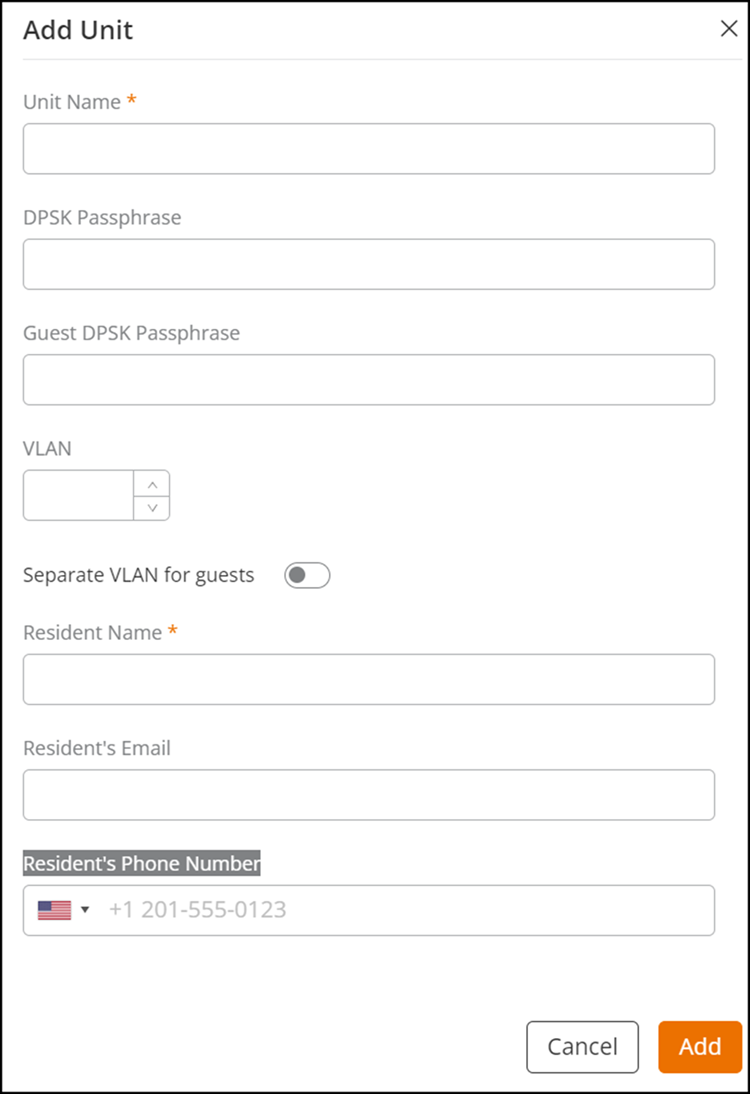
 icon in the upper right-hand corner to export and
download the property unit list in CSV format.
icon in the upper right-hand corner to export and
download the property unit list in CSV format.