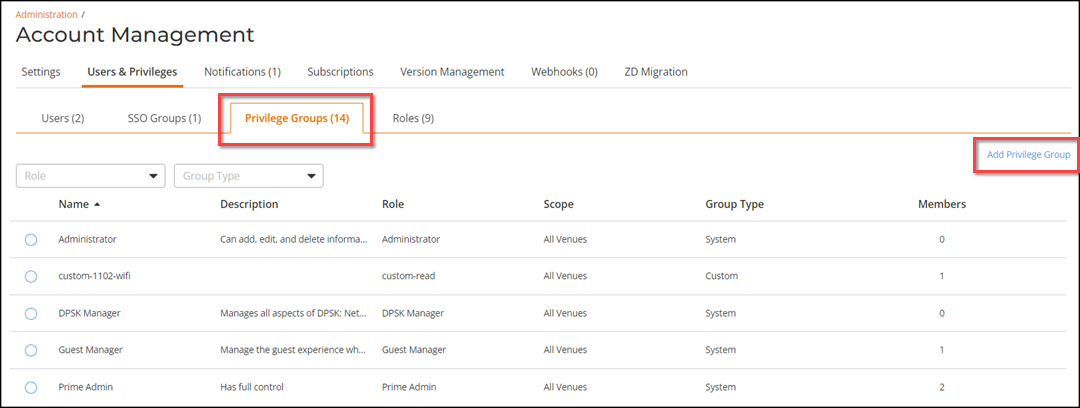
A Privilege Group determines the
venues and customers that a role can access, enabling an administrator to manage devices. By
default, system-defined privilege groups are available, and you can also create custom
privilege groups.
On the navigation bar, select
Administration > Account
Management > Users &
Privileges.
The Account
Management page is displayed.
Click the Privilege Groups
sub-tab.
The following information is
displayed:
Name: Displays
the name of the privilege group.
Note: Once a privilege
group is created and a member is assigned, the
Name cannot be modified; however, other
parameters can be edited.
Description:
Displays a description of the privilege group.
Role: Displays
the system-defined roles and custom roles associated with the privilege
group.
Note:Prime
Admin is supported only for MSP
customers.
Scope: Displays
the venues that can be accessed by the members of the group.
Group Type:
Displays whether the group is system-defined or custom.
Members: Displays
the number of administrators or users associated with the group.
You can filter the list of
privilege group roles by selecting one of the options from the drop-down menu of
the Role and Group Type fields. The
role options include Administrator, DPSK
Manager, Guest
Manager, Prime
Admin, Read Only,
and all custom roles. The group type options are System and Custom.
Account Management -
Adding a Custom Privilege Group
Click Add Privilege
Group.
The New Privilege
Group page is displayed. Complete the following steps before
proceeding to the Scope section:
In the Name
field, enter the name of the group.
Note: You cannot create a
custom privilege group with the same name as a system-defined
privilege group. The name must be unique and cannot contain spaces;
you can use underscores (_).
In the Description field, type a short description for the
group.
From Role,
select the system-defined roles or custom roles from the drop-down
list.
Note:
System administrators are
granted access to most permissions; however, they do not possess the
Account Setup privilege. As notification preferences are managed under
Account Setup,
system administrator accounts are restricted from viewing or modifying
incident notification preferences.
Scope: Define the venues and customers that this role or
privilege group can access.
The Scope
section controls what venues or customers a member can see or manage. The
assigned scope directly impacts permissions, visibility, and control levels.
All Venues: This is the default option. Members
of the Privilege Group with this scope can access all venues.
Specific Venues: Selecting Specific Venues
enables the Select venues hyperlink. Click the
hyperlink to open the Select Venue sidebar, then select
one or more venues using the checkboxes. You can use the Search option to
display only the table entries matching the specified venue; enter a minimum
of two characters. Click Save Selection to confirm,
after which members with this scope can access only the selected venues. Use
Change to modify the scope later if
needed.
Click Add.
The newly created custom
privilege group is added to the list of groups in the Privilege
Groups tab. A notification is displayed on the
Activities page, accessible via the icon at the top
right corner of the RUCKUS One web
interface.
After a privilege group is created, the Members
column in the Privilege Groups tab displays 0 until you add users to the
group. Once users are added, the display automatically updates. Refer to Adding and Managing an Administrator for instructions to
add and manage privilege group members.