Managing Pending Switch Assets
You can view the list of purchased switches that are not yet claimed in RUCKUS One. For each switch, you may claim (effectively adding the switch to a venue managed by your account), hide (stopping the switch from appearing in the displayed list), or do nothing (leaving the switch in the list of Pending Assets). The option to hide devices allows you to proactively control the display of purchased RUCKUS devices that you do not plan to manage with RUCKUS One.
-
Click the
Switch sub-tab and review the following details:
- Serial #: Displays the unique serial number assigned to the switch.
- Source: Displays the origin from which the switch record was added, such as Salesforce or Manual import (CSV).
- Model: Displays the switch model.
- Ship Date: Displays the date when the switch was shipped.
- Created Date: Displays the date when the switch entry was created in the system.
- Visibility: Displays whether the switch is
visible or hidden.Note: Salesforce data takes precedence over manually imported data, and fields such as Model, Ship Date, and Created Date are updated when a duplicate device exists.
You can use the Search option to display only the entries matching a specific Serial #, Source, or Model. Additionally, you can filter the list by selecting one of the options from the Model drop‑down menu and the Created Date filter. The Model drop‑down list displays the available models, and the Created Date calendar enables you to select a predefined or custom date range. The available date options are Last 1 Hour, Last 2 Hours, Last 4 Hours, Last 6 Hours, Last 8 Hours, Last 12 Hours, Last 24 Hours, Last 7 Days, Last 30 Days, and All Time. Click Clear Filters to remove the applied filters. The Created Date filter then resets to All Time if it was changed to another date option. You can sort the list by clicking the associated column header.
You can customize which fields appear in the Switch table by clicking the
 icon and selecting or deselecting the desired column names. Drag and drop
individual column names up or down the list to customize the left‑to‑right
column display in the table. Optionally, you can click Reset to default
to restore the default subset of columns.
icon and selecting or deselecting the desired column names. Drag and drop
individual column names up or down the list to customize the left‑to‑right
column display in the table. Optionally, you can click Reset to default
to restore the default subset of columns. -
(Optional) Click on the
 icon to reload the latest pending asset information.
Refreshing the list syncs data with Salesforce. This operation adds newly discovered switches and updates existing records, including those previously added through manual CSV import.Note: The Updated at field displays the last page update time and date.
icon to reload the latest pending asset information.
Refreshing the list syncs data with Salesforce. This operation adds newly discovered switches and updates existing records, including those previously added through manual CSV import.Note: The Updated at field displays the last page update time and date. -
Claim one or more devices by
clicking the associated checkbox(es) and then clicking Claim
Device.
Note: You can claim up to 10,000 devices at a time.The Claim Device sidebar is displayed.
Pending Assets - Switch - Claim Device 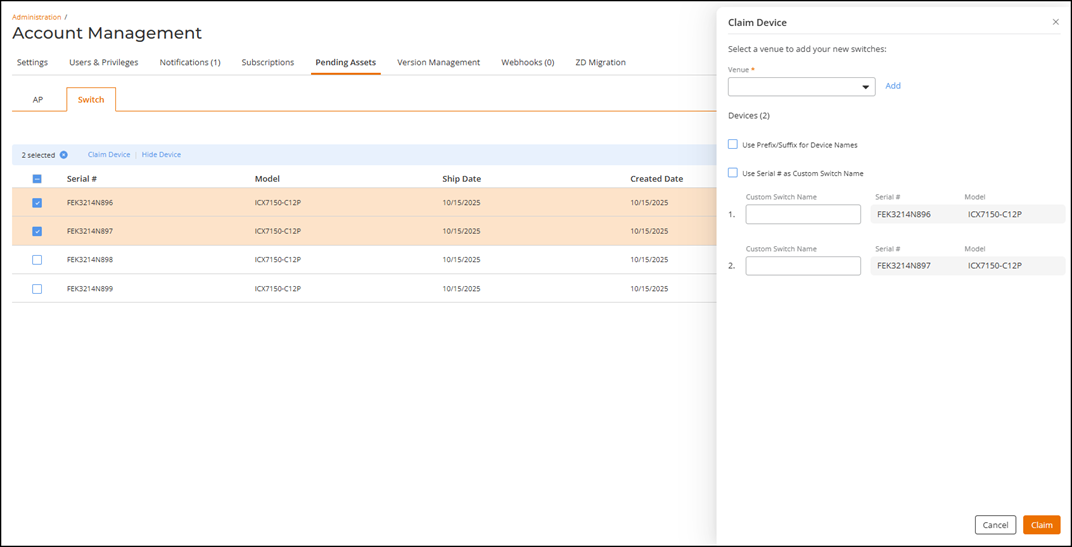
- Select the Venue
from the drop-down menu.
If the venue is not yet defined, you can create a new venue: click Add, complete the fields in the Add Venue sidebar, and click Add. You are then able to select the new venue from the Venue drop-down. Refer to Adding a Venue for information on how to add a new venue.
- (Optional) Select the
checkbox Use
Prefix/Suffix for Device Names and enter the
Prefix and Suffix
fields.
The system will name the device by placing the prefix at the beginning, the custom name in the middle, and the suffix at the end.
- (Optional) Select the
checkbox Use
Serial # as Custom Switch Name. Note: The system auto-populates the Custom Switch Name, Serial #, and Model.
- Click Claim.
You can view the claimed device on the Switch List page. For detailed page content descriptions, refer to Viewing the Switch List.
- Select the Venue
from the drop-down menu.
-
(Optional) Click Import.
The Import from file sidebar is displayed.
Complete the following steps to import Pending Switch Assets:
-
Click the
 icon to view the import status.
After an import operation completes, the Activities sidebar displays the import result, including the number of pending assets imported successfully and the number that failed. When failures occur, you can download a detailed error report directly from the corresponding activity notification.
icon to view the import status.
After an import operation completes, the Activities sidebar displays the import result, including the number of pending assets imported successfully and the number that failed. When failures occur, you can download a detailed error report directly from the corresponding activity notification.The error report can include entries for an incorrect serial number format, duplicate serial numbers in the CSV file, serial numbers that already exist in Pending Assets, serial numbers that exist in Pending Assets for another tenant, or serial numbers that are already registered.
-
Click the