You can view details about the ICX
switch panel, such as the port-side, non-port side, traffic trends, and floor plans, from
the RUCKUS One web interface.
On the navigation bar, select
Wired >
Switches > Switch
List.
The
Switches page is displayed, defaulting to the Switch
List tab.
Click the switch name to view
the panel details.
The details page is
displayed for the switch, defaulting to the Overview
tab.
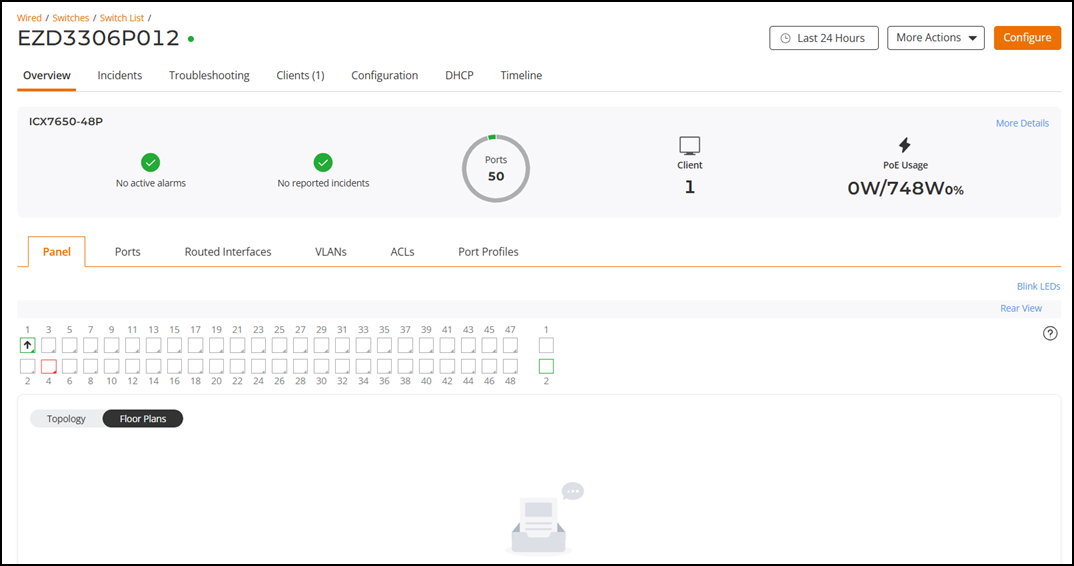
Click the Panel sub-tab to displays a graphical representation of the
switch front panel (port side) by default.
The tab dynamically displays either a single switch or multiple stack
members, depending on the switch configuration.
For a standalone switch: Displays a single panel showing the switch
model and its complete port layout.
For a switch stack: Displays each stack member as a separate panel with
its unit number, role (Active or Member), PoE usage, and port
configuration.
Overview Tab - Panel
Review the stack members
displayed individually, each with its own panel and port configuration.
Disconnected members appear inactive and are visually
distinguished from active members, while members that have never connected to
the cloud are indicated as Never
Connected.
Click Remove in
the Panel tab to delete the offline stack
member.
Note: The Remove option is available only for disconnected
members and is not displayed for active or connected members.
Click the Rear View
hyperlink to view the non-port side. To switch back, click the Front View
hyperlink.
Note: Front and rear views of the switch are available.
The Front View (port side) is displayed by default.
Note: The ICX 8100 and ICX 8100-X models are now
supported and appear in the list. Some advanced metrics (like
breakout ports) are not applicable to ICX 8100. Stacking details
appear only for ICX 8100-X.
Each switch in the stack is
shown with its unit
number, status (Active
or Standby), and PoE usage
summary. Icons such as S
(Stack Port) or arrow
(Uplink) indicate specific port roles.
Hover your cursor over a port slot to display a tooltip showing the following
information:
Port:
Displays the port number of the switch.
Name:
Displays the port name of the switch.
VLAN:
Displays the VLAN assigned to the switch port.
Port
Speed: Displays the speed of the switch port.
ErrDisabled: Specifies whether the port is in an
error-disabled state (Yes or No). When a port is in an error-disabled
state, the port slot in the front panel of the switch is indicated in
red.
ErrDisable
Reason: Displays the reason for the port being in the
error-disabled state.
Note:ErrDisabled and ErrDisable
Reason fields are supported only in RUCKUS FastIron
releases 10.0.10 (versions 10.0.10g or later) and 10.0.20 (versions
10.0.20b or later).
Port
State: Displays the status of the switch (Up or
Down).
Connected
Device: Displays the name and IP address of the next
neighbor device for a switch, and the neighbor port number for a stack
connection.
PoE Usage
(Consumed/Allocated): Displays the PoE usage level of the switch
port.
PoE Device
Type: Displays the PoE type used by the switch.
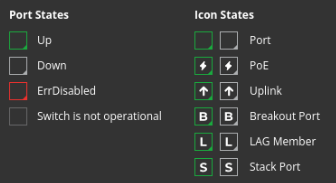
(Optional) Click to learn about the port
slot indications on the switch front panel.
Switch Front Panel -
Port and Icon States
(Optional) Click any port slot to open the Edit Port
sidebar, where you can view or modify detailed configuration and status
information.
(Optional) Click Blink LEDs to open a sidebar that
allows you to make the switch’s LEDs blink for easier physical identification.
You can set the duration between 15 and 120 seconds and
select whether to blink LEDs on all units or a specific stack
unit. Click Start to begin blinking or
Cancel to exit.
Review the visual charts in the Panel tab to monitor switch activity and
health.
The following details are displayed:
Traffic Overview: Displays total switch traffic trends over time.
You can view aggregate traffic or select specific ports, see throughput
categorized by Tx, Rx, and Total traffic and hover
over data points to view exact traffic values.
Resource Utilization: Shows CPU, memory, and
PoE usage percentages to help identify load conditions
and power allocation issues.
Top 10 Ports by Traffic: Displays the ten ports handling the
most traffic. You can view the real-time data chart or a donut graph
summarizing usage per port.
Top 10 Ports by
Errors: Lists the ports with the highest error counts. A
donut chart and time-based graph help identify error trends and
affected interfaces. Hover your cursor over any chart element to
view more detailed data.
Click Floor
Plans tab to view the switch placement if it is mapped to a floor
plan. If not, a message appears indicating that the switch is not placed on any
floor plan.
Click
Topology tab to view the logical switch or stack
topology view.
 to learn about the port
slot indications on the switch front panel.
to learn about the port
slot indications on the switch front panel.