Managing Switch Backup Configurations
You can use the Restore & Backup page to create a switch configuration backup, as well as view, restore, download, compare, and convert existing configuration backups, as needed. These options help you quickly recover switch settings, maintain consistent configurations, and minimize downtime when configuration changes are applied.
-
Select the Configuration tab.
The Restore & Backup tab view opens by default, displaying the list of configuration backups with details such as Name, Date, Type, and Status.
You can customize which fields appear in the Restore & Backup table by clicking the
 icon and selecting or deselecting the desired column names. Optionally,
you can click Reset to default to restore the default subset of
columns.
icon and selecting or deselecting the desired column names. Optionally,
you can click Reset to default to restore the default subset of
columns. -
(Optional) Click File Name
Preference to configure the file name syntax for newly generated
backup files; names of existing files are not impacted.
The File Name Preference dialog box is displayed.
-
Select a Naming
Pattern. The available options are:
- Default (Serial number + Date)
- Switch Name + Date
- Switch Name + Serial Number + Date
- Custom
Tag: Select and complete one of the following
options:
- Prefix: Enter a prefix value (maximum 32 characters).
- Suffix: Enter a suffix value (maximum
32 characters).Note: You can use either a prefix or a suffix, but not both at the same time.
File Name Preference 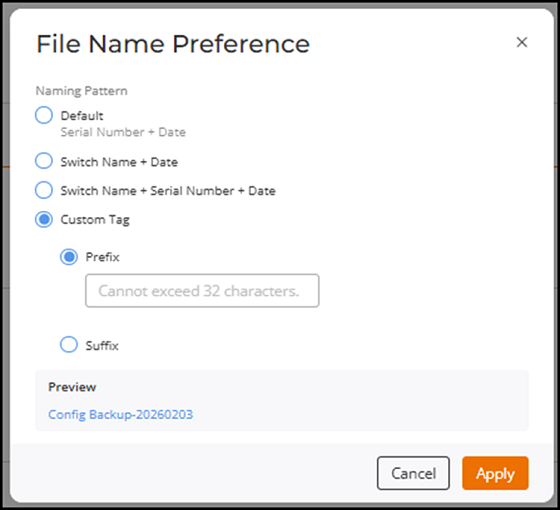
When you click Backup Now on the Restore & Backup page, the configuration backup file name is displayed based on the selected naming pattern. You can still modify the file name manually before confirming. -
Select a Naming
Pattern. The available options are:
-
Click the checkbox next to the
name of any configuration backup to display and access the following
options
- View
- CompareNote: The Compare option is enabled only when two configuration backups are selected.
- Restore
- Download
- Convert into Template
- Delete
Configuration - Restore and Backup Options 
When you initiate an Update Now or scheduled ICX switch firmware upgrade, RUCKUS One automatically backs up the current switch configuration before starting the upgrade. This backup provides a restore point containing the configuration associated with the switch firmware version before the upgrade.
For an upgrade that uses image pre-download, RUCKUS One creates the backup before the switch reloads, not when the firmware image is downloaded. The switch reload proceeds only after the backup is completed successfully.
The Restore & Backup tab displays the backup with Pre-upgrade in the Type column. The Version column displays the switch firmware version at the time the backup was created.
Note: If the pre-upgrade configuration backup fails or times out after the retry attempts, RUCKUS One stops the firmware upgrade and generates a switch firmware upgrade failure event. Resolve any connectivity or backup issues, and then initiate the upgrade again. You cannot skip the pre-upgrade backup.Note: Pre-upgrade backups count toward the existing limit of seven configuration backups. When the limit is exceeded, RUCKUS One applies the existing backup retention behavior.Note: RUCKUS One does not create a pre-upgrade configuration backup for the firmware upgrade performed during initial switch onboarding. -
(Optional) Click Restore to
replace the current configuration on the switch.
A confirmation message is displayed, indicating that restoring a configuration replaces the existing configuration on the switch with the selected backup. This operation triggers the switch or stack to reload, which may temporarily affect network traffic.
- Click Restore
to proceed.
- The switch reboots automatically after the configuration restore, resulting in brief network downtime. After the reboot, the switch resumes forwarding traffic.
- After connecting to the HTTPS-based cloud servers, the switch status is displayed as Operational once the backed-up configuration and all necessary synchronizations are complete.

- Click Restore
to proceed.
-
(Optional) Click Convert into Template to convert a
configuration backup into a reusable CLI template.
Note: You can use this feature to simplify network management by reusing switch configuration backups as templates, ensuring consistency and reducing configuration errors across multiple devices.Note: Only one configuration backup can be selected at a time for conversion. If no backup exists, create one using Backup Now first.
-
Click the CLI Examples tab.
The CLI Examples tab displays a categorized list of common CLI command examples that can be inserted into the configuration. Hover your cursor over each command category to display a pop-up containing all the associated commands. You can place your cursor anywhere in the CLI commands panel, then click the
 icon to insert all commands associated with
the selected CLI Example category into the CLI editor panel. Note that
when using a command from the CLI Examples list,
you must replace any command input field that is enclosed in < >
and displayed in orange with the desired value (after which the color
changes to black).
icon to insert all commands associated with
the selected CLI Example category into the CLI editor panel. Note that
when using a command from the CLI Examples list,
you must replace any command input field that is enclosed in < >
and displayed in orange with the desired value (after which the color
changes to black). -
Click Convert.
The backup is converted into a CLI template and is displayed in the On-Demand CLI Configuration page.
Convert into Template 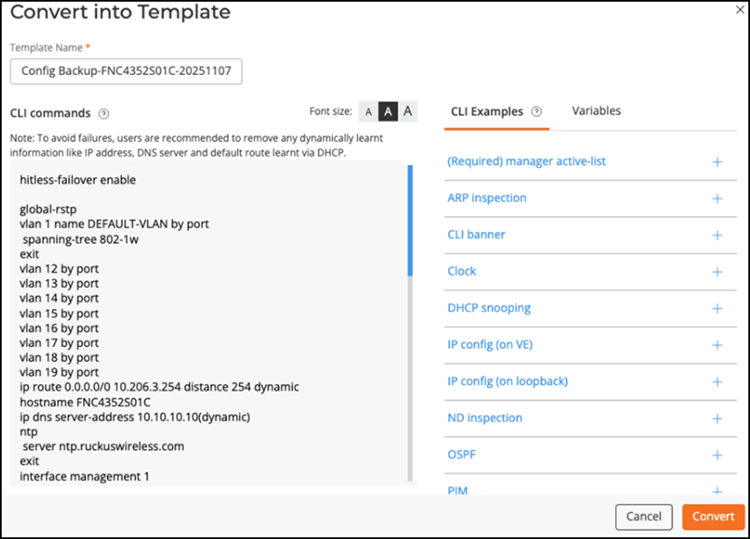
-
Click the CLI Examples tab.