After setting up the customer portal,
you can add your end customers and assign integrators or installers to your
customers.
Complete the following steps to add an end
customer.
On the navigation bar, select
My
Customers > MSP
Customers.
The MSP
Customers page is displayed.
On the MSP
Customers page, click Add
Customer.
The Add Customer
Account page is displayed.
Enter a unique customer name in
the Customer
Name field.
Type the address in the
Address field, then select a validated option from the
suggestion list.
The system automatically
populates the validated address. You cannot manually type and save the
address. If you do not select a suggestion, or if the system cannot validate
the address, you see an error prompting you to select an address from the
suggestion list.
Add tags by typing in the
Tags
field, where a dropdown will automatically show existing tag suggestions that
you can select. If the tag does not already exist, simply type the new tag name
and press Enter to create it.
These tags allow MSP Admins to
label, categorize, and organize MSP End Customers using custom, user‑defined
keywords. These tags also help in filtering and searching customer
accounts.
Note: You can add up to 20 tags per End Customer, and each
tag must begin with an alphabet, be no longer than 60 characters, use only
letters (A–Z, a–z), numbers (0–9), or the special characters (such as -, #, :, ., $, *, and _) and cannot contain
spaces.
Click Manage next to
MSP
Delegations.
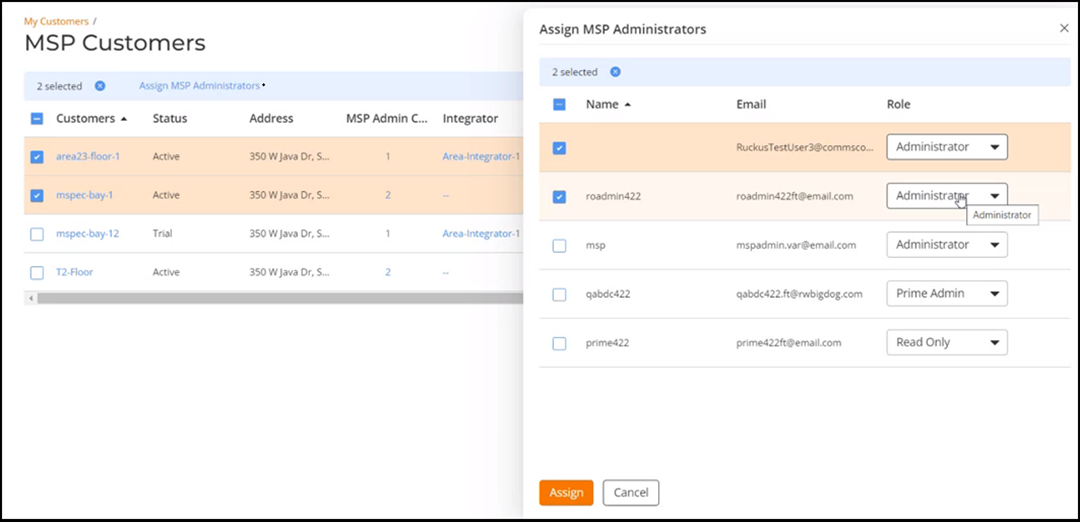
The Manage MSP
Delegations sidebar is displayed, defaulting to the Users tab.
Select one or more MSP
administrators by clicking the checkbox alongside each user's
name.
You can use the Search
option to display only the table entries matching the specified Name or Email; enter a
minimum of two characters. You can sort the list by clicking the
associated column header.
Select a system role
from the Role drop-down list.
Manage MSP
Delegations - Users Tab
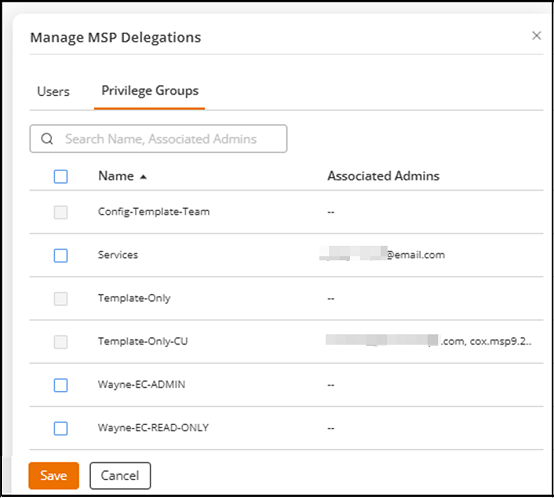
Click the
Privilege Groups tab.
Manage MSP
Delegations - Privilege Groups Tab
Select one or more MSP
Privilege Groups by clicking the checkbox alongside each privilege
group's name to assign custom roles.
You can use the Search
option to display only the table entries matching the specified Name or Associated
Admins; enter a minimum of two characters. You can sort the list by
clicking the associated column header.
Note: From Administration > Account Management > Users
& Privileges > Privilege Groups > Add
Privilege Group, the Privilege Group with the scope set to All MSP
Customers is selected by default and cannot be
modified. In contrast, a Privilege Group with the scope set to
Specific Customer(s) allows you to change its scope
at any time by selecting or clearing the checkbox.
Click Save.
Note: The MSP Delegations
section on the Add Customer Account page
displays the role of Users and the
associated Privilege Groups in parentheses.
Click Manage next to
Integrator.
The Manage
Integrator sidebar is displayed. The page lists existing
integrators that you can assign to the end customer.
Select one or more
integrators.
You can
use the Search option to display only the table entries matching the
specified Name; enter a minimum of two characters.
Click Save.
Click Manage next to
Installer.
The Manage
Installer sidebar is displayed. The page lists existing
installers that you can assign to the end customer.
Select one or more
installers.
You can
use the Search option to display only the table entries matching the
specified Name; enter a minimum of two characters.
Click Save.
(Optional) Toggle the Customer
Administrator switch on to add a customer administrator.
Complete the following steps to
add a customer administrator.
Enter the
administrator’s email address in the Email
Address field.
Enter the first and last
name of the administrator in the First
Name and Last Name
fields.
Select a role from the
Privilege Group drop-down list.
Click Next.
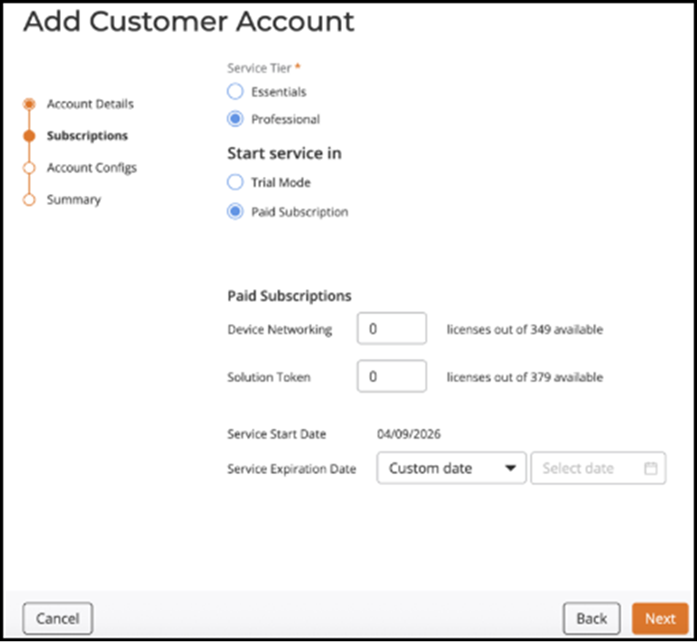
The Subscriptions page is displayed.Add Customer Account -
Subscriptions
Select the Service
Tier for the end customer. The options are:
Essentials: If you select
Essentials, the customer cannot benefit from
certain advanced features including Service Validation,
Config Change, and Video Call
QoE.
Professional: If you select
Professional, the customer can benefit from
advanced features such as Service Validation,
Config Change, and Video Call
QoE.
In RUCKUS One, MSPs are
at the Professional tier by default, and end customers
inherit the MSP tier. However, now MSPs have the flexibility to choose the
Service Tier as Essentials or
Professional for their end customers.
Note:
You can upgrade or
downgrade the subscription tier any time. For more information,
refer to Editing an End Customer.
To view the service
tier in the tenant portal, click Manage My
Account to go to the tenant portal for your own RUCKUS One account. Select Administration >
Account Management >
Subscriptions.
Select the Start
service in mode for the end customer.
By default, Trial Mode is
selected. The Trial Mode section displays Device Networking
(trial licenses), Trial Start Date and Trial End Date.
Note: The Trial Mode
subscription is valid for a maximum of 30 days, starting from the date of
activation. Once the trial period ends, the subscription becomes inactive.
The status can be viewed on the MSP Customer page, and
network services are interrupted until a paid subscription is
activated.
Note: You can upgrade from Trial Mode to
Paid
Subscription. For more information on licensing, refer to
the RUCKUS One
Subscriptions Licensing Guide.
The Extended Trial
Mode section displays Device
Networking, Service Start
Date and Service Expiration
Date. Based on the current configuration, the minimum licenses
required are computed and displayed.
Note:
To ensure accuracy, the
system validates the service details by checking that the Service
Expiration Date is valid and that a Device Networking license is
available. If both checks succeed, the service is accepted; if either
check fails, a message is displayed instructing you to recheck the
service details.
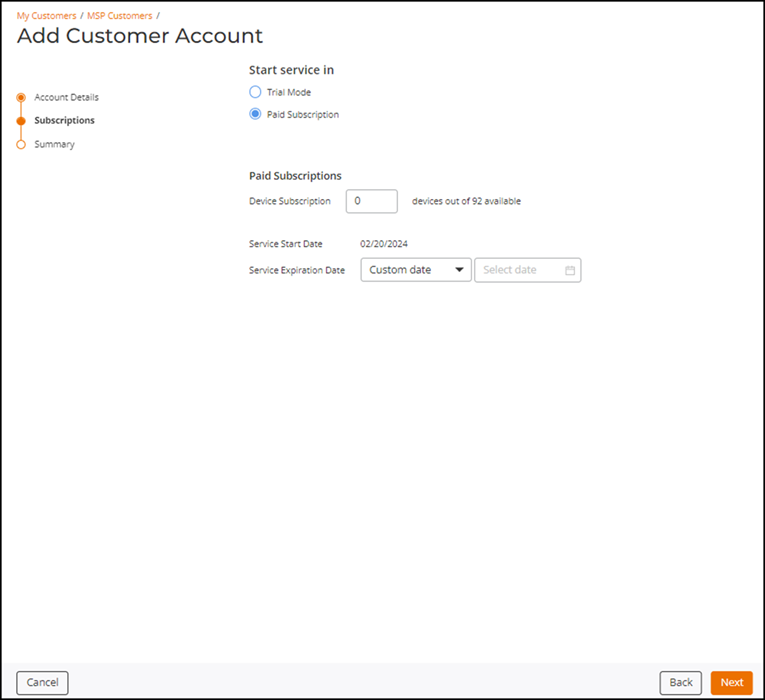
For Paid
Subscription, specify the Device
Networking and the Service Expiration
Date.
Enter the required
license counts in Device
Networking and Solution
Token fields.
Select the Service Expiration
Date from the drop-down list. The options
include
Custom date, Five
Years, Three
Years, One Year,
90
Days, 60 Days,
and 30
Days. The date auto‑populates in all cases except Custom date.
Select a date when Custom
date is selected.
Add Customer Account -
Paid Subscription
Click Next.
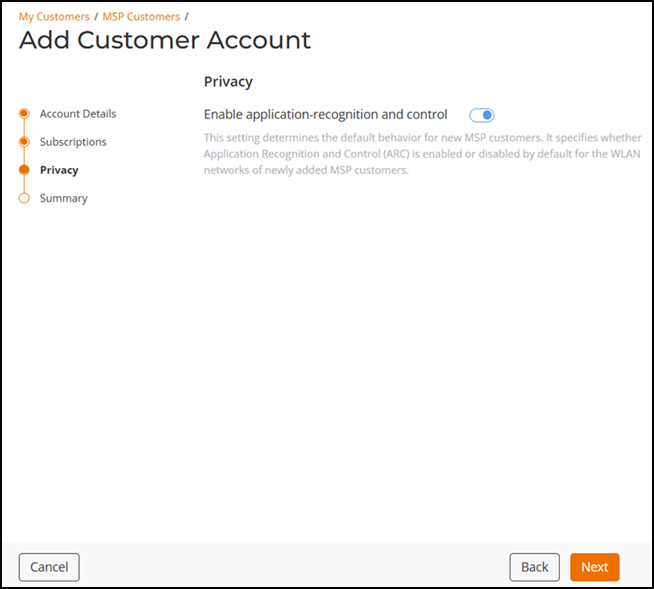
The Account
Configs page is displayed.
Toggle the Enable
application-recognition and control switch on to enable this
setting. This setting specifies whether Application Recognition and Control
(ARC) is enabled or disabled by default for the WLAN networks of newly added MSP
customers.
Note: The configuration follows
the setting at the MSP administration level. Only Prime Admins and
Administrators can override this setting.
Select one or more tags in the
Tags
field. These tags are used to select default templates that will be applied when
an MSP end customer is created.
The Tagged Templates
list updates automatically based on your tag selections.Add Customer Account -
Account Configs
(Optional) Perform one of the
following actions for templates that support overrides (for example, Venue
templates):
Click Override
Template.
The Override Venue
Template dialog box is displayed.
Edit fields such as
Venue
Name, Description, and Address.
Click Override.
The Edit
Override and Delete
options are then displayed for overridden Venue templates.
(Optional) Click
Edit
Override to update an existing override.
(Optional) Click
Delete to remove an override.
All selected
templates and overrides are automatically applied to the customer after
account creation.
Click Next.
The Summary page is
displayed.
Review the customer information
and verify that selected tags and selected templates appear correctly on the
Summary page.
Click Add Customer.
The newly added customer appears on the MSP
Customers page.